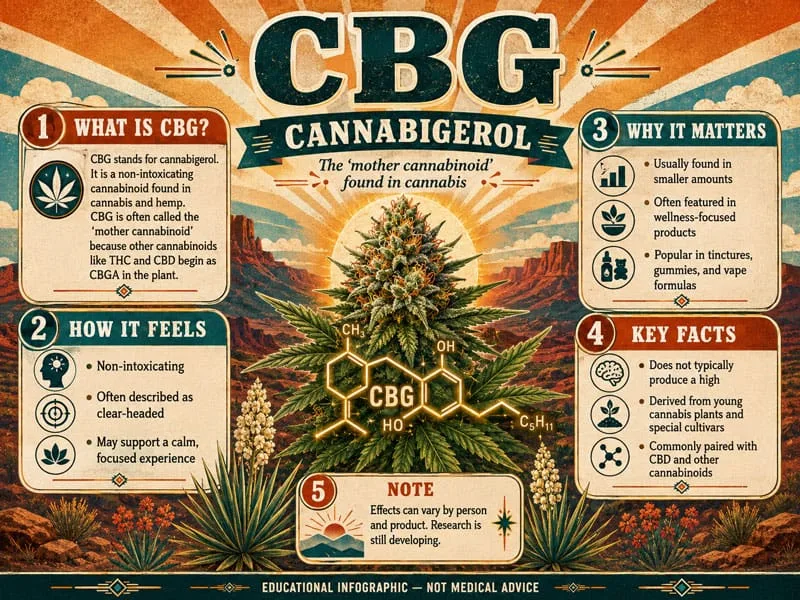
Anyone browsing a New Mexico dispensary menu lately has probably noticed CBG popping up alongside the usual THC and CBD numbers. Cannabigerol, or CBG, has earned the nickname “mother cannabinoid” because the plant produces it first, in the form of CBGA, before enzymes convert that precursor into THCA, CBDA, and the other acidic cannabinoids as the plant matures. By the time flower is fully developed, only a small fraction of CBGA is left, which is part of why CBG shows up in lower concentrations than THC or CBD in most mature cannabis strains.
Despite the small quantities, CBG has drawn real scientific interest. A 2024 double-blind, placebo-controlled study published in Nature’s Scientific Reports found that a single dose of CBG produced statistically significant reductions in participants’ self-reported anxiety and stress ratings, along with improved verbal memory performance, without the intoxication or cognitive slowing associated with THC. Researchers at Washington State University have continued that work, and a follow-up clinical trial on the acute psychological and physiological effects of cannabigerol wrapped up earlier this year. Most of what’s known about CBG beyond that still comes from lab and animal research: early studies point to anti-inflammatory and antioxidant activity, along with some hypotensive effects observed in animal models, but researchers are clear that human clinical data remains limited and more trials are needed before any firm conclusions can be drawn.
None of this is a claim about what CBG will do for any particular person, and it’s not medical advice — think of it as a snapshot of where the science currently stands, not a settled answer. If you’re a qualifying patient and want to understand how New Mexico’s program treats cannabinoid-specific products, our New Mexico medical cannabis program page is a good starting point, and our cannabis terminology guide breaks down CBG alongside other cannabinoid and terpene terms if you want more background.
Because CBG shows up in such small amounts naturally, most cannabis and hemp brands that highlight it rely on selective breeding or early-harvest genetics to boost the ratio before enzymes convert it further. It’s a reminder that cannabinoid content varies quite a bit strain to strain and even harvest to harvest, which is part of why lab results printed on packaging are worth a look if a specific cannabinoid profile matters to you. Curious shoppers can browse current lab-tested options across all six New Mexico cannabis locations — Albuquerque’s Coors, PanAm, and Alameda stores, plus Santa Fe, Bernalillo, and Hobbs — on our dispensary menus page.