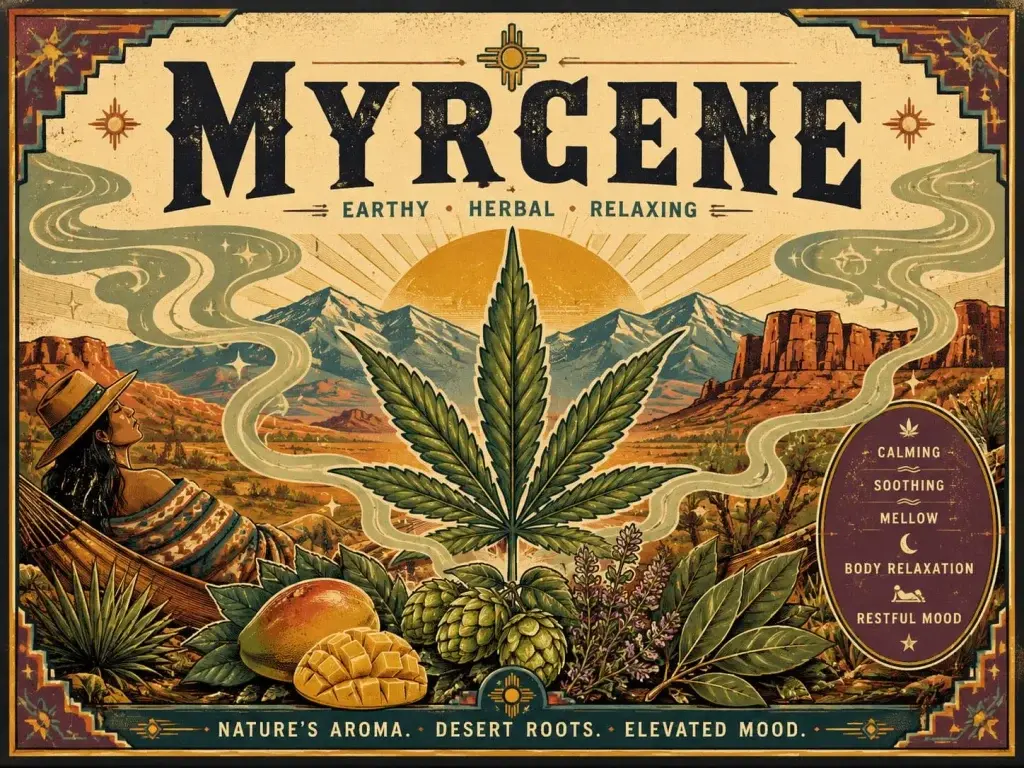
Walk into any New Mexico dispensary and you’ll notice flower doesn’t all smell the same — some jars lean citrusy, others piney, and a lot of them carry a deep, musky, almost mango-like earthiness. That last note is usually myrcene at work, and it’s typically the most abundant terpene found in cannabis.
Terpenes are the aromatic compounds plants produce to attract pollinators and ward off pests, and cannabis makes dozens of them in the same trichomes that produce THC and CBD. Myrcene itself isn’t unique to cannabis — it’s also found in mangoes, hops, lemongrass, and thyme, which is part of why the old “eat a mango before you smoke” theory has stuck around online. Current research hasn’t confirmed that mangoes meaningfully change how cannabis affects a person, but the idea points to something real: scientists are increasingly interested in how myrcene interacts with the body’s endocannabinoid system.
One of the more notable recent findings comes from a UCLA research team, whose study was published in March 2025 in the journal Pain. Working with mouse models of neuropathic pain, the researchers found that myrcene reduced pain sensitivity in a dose-dependent way, and that blocking the CB1 cannabinoid receptor eliminated that effect — suggesting myrcene works through the endocannabinoid system even though, in separate lab tests, it didn’t directly activate CB1 receptors on its own. The study’s authors note the exact mechanism is still being worked out and call for further research. It’s an animal study, not a clinical trial in humans, so the findings are early and shouldn’t be read as proof of an effect in people.
That hedge matters. Terpene research is a genuinely active field, but it’s also one where marketing tends to run ahead of the science. If you’re curious about how cannabinoids and terpenes are thought to interact — often called the “entourage effect” — our cannabis terminology guide is a good starting point for the vocabulary before digging into the research yourself.
Because myrcene shows up in strains grown different ways — indoor hydroponic, greenhouse, organic — terpene profiles can vary even within the same strain name depending on how and where it’s cultivated. It’s one more reason budtenders at our Albuquerque locations, or our Santa Fe, Bernalillo, and Hobbs stores, can be a useful resource if you’re chasing a specific aroma or just trying to learn more about what you’re buying.
This post is general, educational information about published research, not medical advice, and it isn’t a claim about any High Desert Relief product. If you have questions about cannabis and a specific health condition, talk to a qualified medical provider, and see our New Mexico medical cannabis program page for how the state’s program works.
Source: Alayoubi M, et al. “Elucidating interplay between myrcene and cannabinoid receptor 1 receptors to produce antinociception in mouse models of neuropathic pain.” Pain, 2025. Read the study on PubMed.